


Project Menu
Buena Vista
Magnetite Iron Ore
Buena Vista is located approximately 160km east-north-east of Reno in the mining friendly state of Nevada, United States.
The project was discovered in the 1890’s, and in the late 1950’s to early 1960’s around 900,000 tonnes of direct shipping magnetite ore with an estimated grade of 58% Fe was mined. In the 1960’s US Steel Corporation acquired the project and carried out an extensive exploration program including 230 diamond drill holes and considerable metallurgical test work.
In excess of A$34 million has been expended on the Project over the past decade completing feasibility studies and permitting for the long term production of a +67.5 % Fe magnetite concentrate with no deleterious impurities.
The mine site is around 50kms from the Union Pacific rail line which connects with multiple export port options including Stockton, West Sacramento, Oakland, San Francisco and Richmond (Levin).
Grid power is available within 40km of the deposits and sufficient water can be sourced from ground water aquifers located in the North Carson sink. The Nevada Department of Conservation and Natural Resources has already granted the required water rights for the life of the mine.

Location of the Buena Vista Project and surrounding infrastructure, USA.
Buena Vista is located approximately 160km east-north-east of Reno in the mining friendly state of Nevada, United States.
The project was discovered in the 1890’s, and in the late 1950’s to early 1960’s around 900,000 tonnes of direct shipping magnetite ore with an estimated grade of 58% Fe was mined. In the 1960’s US Steel Corporation acquired the project and carried out an extensive exploration program including 230 diamond drill holes and considerable metallurgical test work.
In excess of A$34 million has been expended on the Project over the past decade completing feasibility studies and permitting for the long term production of a +67.5 % Fe magnetite concentrate with no deleterious impurities.
The mine site is around 50kms from the Union Pacific rail line which connects with multiple export port options including Stockton, West Sacramento, Oakland, San Francisco and Richmond (Levin).
Grid power is available within 40km of the deposits and sufficient water can be sourced from ground water aquifers located in the North Carson sink. The Nevada Department of Conservation and Natural Resources has already granted the required water rights for the life of the mine.
Geology
The Buena Vista magnetite deposits are the product of late stage alteration of a localized intrusive local gabbro that resulted in intensely scapolitised lithologies and the deposition of magnetite.
The most well-known example of this type of magnetite mineralization is the Kiruna magnetite deposit in Sweden which has been in production since the early 1900’s.
The distribution and nature of the magnetite mineralization at Buena Vista is a function of ground preparation by faulting and fracturing forming a series of open fractures, breccia zones and networks of fine fractures.
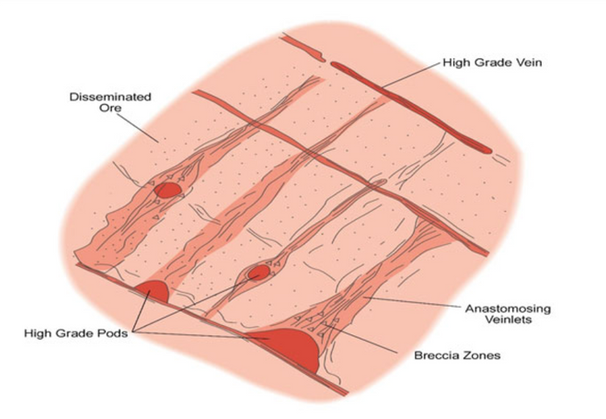
As a consequence the magnetite mineralisation has been developed as disseminations within the altered gabbro through to massive pods and occasionally vein like intrusions.
These ground conditions produce variations in mineralization types from massive pods grading +60% magnetite to lighter disseminations grading 10-20% magnetite.
The mineralisation has been best developed within a number of discrete but proximal deposits (Section 5, West and East deposits) that outcrop and exhibit a strong magnetic signature.
The strike of the deposits is approximately east-west for the Section 5 and West deposits and south west-north east for the east deposit. The dip is generally towards the north.


Metasomatic magnetite deposits such as those at Buena Vista have important beneficiation advantages over the other main type of magnetite deposit which is a banded iron hosted magnetite, also sometimes known as a taconite.

Buena Vista has been extensively drilled with three main programmes having been carried out.DRILLING EVALUATIONThe initial programme was by Columbia Mines (US Steel) in the early 1960’s and was by BQ, NQ and HQ diamond drilling and holes were surveyed for dip using a Tropari instrument.
A total of around 112 holes for 18,215 metres was completed and all holes were geologically sampled and logged.
Around 5,000 samples across the magnetite mineralized zones were taken from the drill core and the magnetite content determined by Davis Tube. All testing was carried out at the Colorado school of Mines Research foundation.
In 2010 a confirmatory diamond drill programme of 8 holes comprising 1,415 metres was carried out by Richmond Mining Limited. This programme, which was HQ was designed to twin various 1960’s holes in order to test for vertical and lateral continuity as well as provide QA/QC information on the historic drilling.All of the holes were geologically logged and then halved or quartered and samples assayed by American Assay Laboratories in Reno and SGS Laboratories in Perth.
In 2012 Nevada Iron Limited carried out a programme comprising 19 drill holes for 3,431 metres of HQ diamond drilling and 50 holes for 13,024 metres of 138 mm reverse circulation drilling.
This programme was designed to provide infill drilling for an expanded resource estimate, extend the boundaries of the known mineralized areas and provide additional core for definitive metallurgical beneficiation test work. All drill holes from this programme were geologically logged and the diamond holes surveyed down hole.
Samples from this programme were prepared by ALS Global Laboratories in Reno and analysed by ALS Laboratories in Perth.
Metallurgy
Unlike banded iron hosted magnetite deposits (taconites) where the magnetite mineralization is finely disseminated in siliceous bedding planes, the Buena Vista ore is of magmatic origin and as a consequence is coarser grained in association with the siliceous host rock.
The prime benefit of this is that metallurgical test work has shown that the primary crush of the Buena Vista ore on average increases the mill grade to +45% irrespective of the primary ore grade. This is an important distinction to taconites and results in reduced energy usage for the subsequent crushing and grinding upgrade to the concentrate grade of +67.5%.The Buena Vista concentrate contains no deleterious concentrations of impurities with silica typically 1.4-1.5%, alumina less than 1% and negligible sulphur and phosphorous content (around-0.003% respectively).
In addition titanium and vanadium levels are low in the Buena Vista concentrate, typical levels are around 0.2% TiO2 and 0.3% V.

Buena Vista Composite Concentrate -150 mesh (106 microns) (After GR Engineering 2011)

Surface grade distribution (2011 Feasibility Study)